Sage vs Xero 2026: Which Is Actually Better for UK Small Businesses?
The definitive Sage vs Xero comparison for UK small businesses in 2026. Pricing, payroll, bank reconciliation, MTD, AI features, CIS, app integrations, and real monthly cost tables.
Ledger Businesses is reader-supported. When you buy through links on our site, we may earn an affiliate commission at no extra cost to you. Learn more.
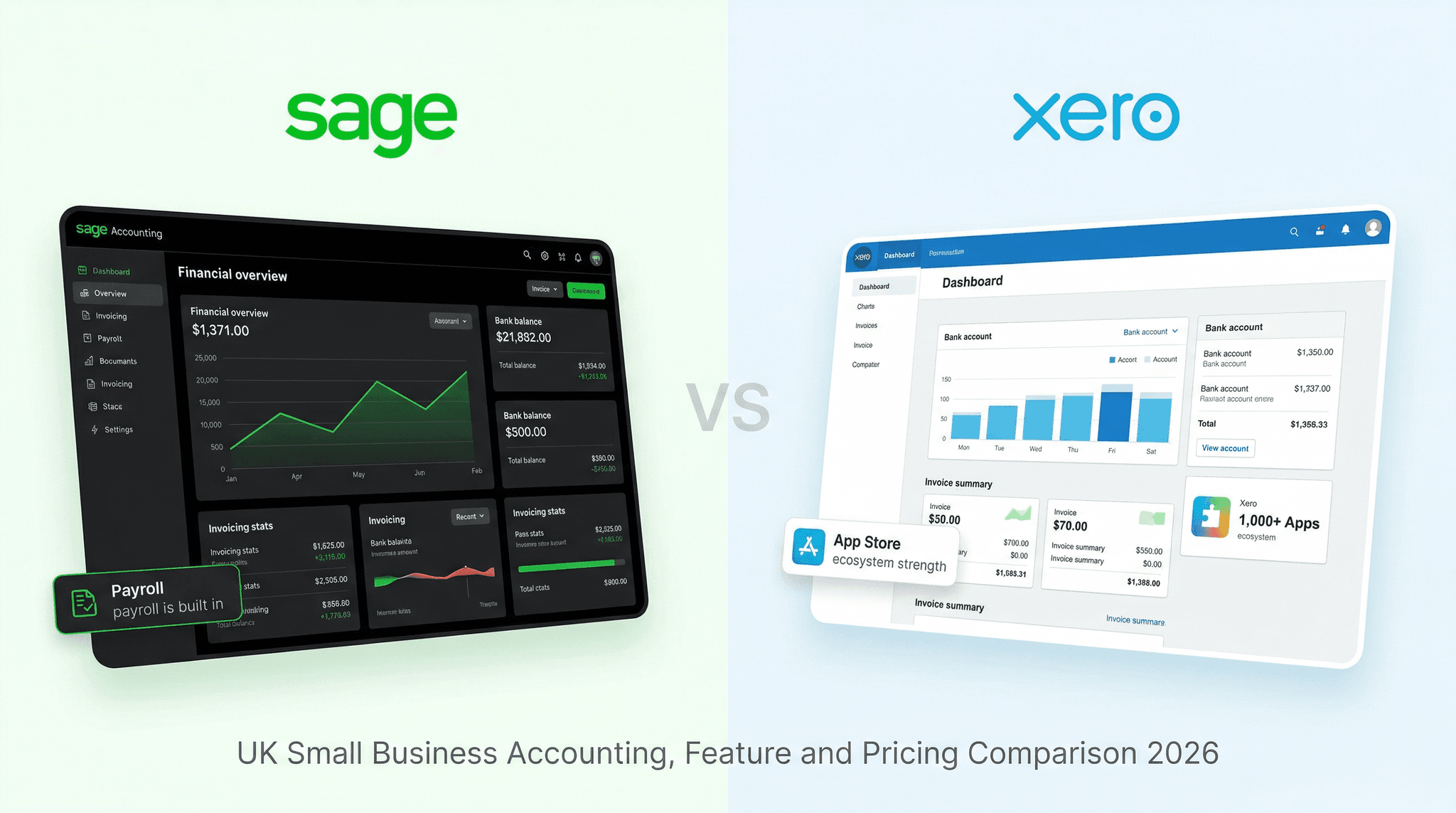
Sage and Xero have been competing for the UK small business accounting market for well over a decade. Both are cloud-native, both are MTD-compliant, and both are used by hundreds of thousands of UK businesses. But they have developed along very different lines — and the "better" choice depends almost entirely on the specifics of your business. This comparison covers every meaningful dimension, including the real monthly costs once payroll is factored in.
We have kept this comparison honest. Xero wins in some areas; Sage wins in others. The goal is to give you enough information to make the right decision for your business, not to declare an unconditional winner.
Sage is the stronger choice for businesses with employees, especially those in construction (CIS) or anyone who values UK phone support and bundled payroll. Xero wins on third-party app integrations and bank reconciliation user experience. For a five-employee business, Sage works out cheaper when payroll is included. For a sole trader or micro-business without employees, the choice is closer.
Pricing: Plan-by-Plan Comparison
Both Sage and Xero use tiered monthly subscription pricing, billed monthly or annually (with a small discount for annual billing). Sage's current promotional pricing includes 90% off for the first three to six months — making the initial cost extremely low — while Xero periodically offers similar introductory discounts.
| Feature Level | Sage Plan | Sage Price/mo | Xero Plan | Xero Price/mo |
|---|---|---|---|---|
| Entry / invoicing only | Accounting Start | £15 | Ignite | £16 |
| Core accounting | Accounting Standard | £30 | Grow | £37 |
| Advanced / multi-currency | Accounting Plus | £59 | Comprehensive | £50 |
| Top tier / full suite | Accounting Plus | £59 | Ultimate | £65 |
At the entry and mid levels, Sage is marginally cheaper. At the upper end, Xero's Ultimate plan at £65/month includes payroll for up to 10 employees (via Xero Payroll as part of the bundle) and expenses — though the per-employee fees kick in beyond that. Sage Accounting Standard at £30/month also includes payroll, making the Standard plan particularly strong value for small employers.
What Each Entry Plan Includes
The Sage Accounting Start and Xero Ignite plans are both limited entry products. Sage Start includes: unlimited invoices and quotes, bank feeds for one bank account, VAT returns and MTD submissions, Sage Copilot AI, and basic cash flow overview. The plan is restricted to one user. Xero Ignite similarly offers invoicing and quotes (but capped at 20 invoices and 5 bills per month on the entry plan), bank reconciliation, and MTD VAT. Both are suitable for very early-stage sole traders but both impose restrictions that make them unsuitable as a business grows.
The Real Cost: Payroll Makes the Difference
The plan-level pricing comparison above misses the most important number for most UK businesses: payroll. Sage bundles payroll into the Accounting Standard plan at no extra charge per employee. Xero requires a separate payroll add-on at additional per-employee cost. This changes the economics substantially once you employ even a small number of people.
| Business Size | Sage Standard + Payroll | Xero Grow + Payroll | Monthly Saving with Sage |
|---|---|---|---|
| 1 employee | £30/mo (all-in) | £37 + £1.50/employee = £38.50/mo | £8.50/mo |
| 5 employees | £30/mo (all-in) | £37 + £7.50 = £44.50/mo | £14.50/mo |
| 10 employees | £30/mo (all-in) | £37 + £15 = £52/mo | £22/mo |
| 25 employees | £30/mo (all-in) | £37 + £37.50 = £74.50/mo | £44.50/mo |
The savings compound dramatically at larger employee counts. A 25-employee business using Sage Standard saves over £530 per year compared to equivalent Xero functionality — purely from the bundled payroll. Note: Xero's Comprehensive plan includes payroll for up to 10 employees within the £50/month price, so the comparison shifts slightly for businesses at that scale. Beyond 10 employees, per-employee Xero payroll charges resume.
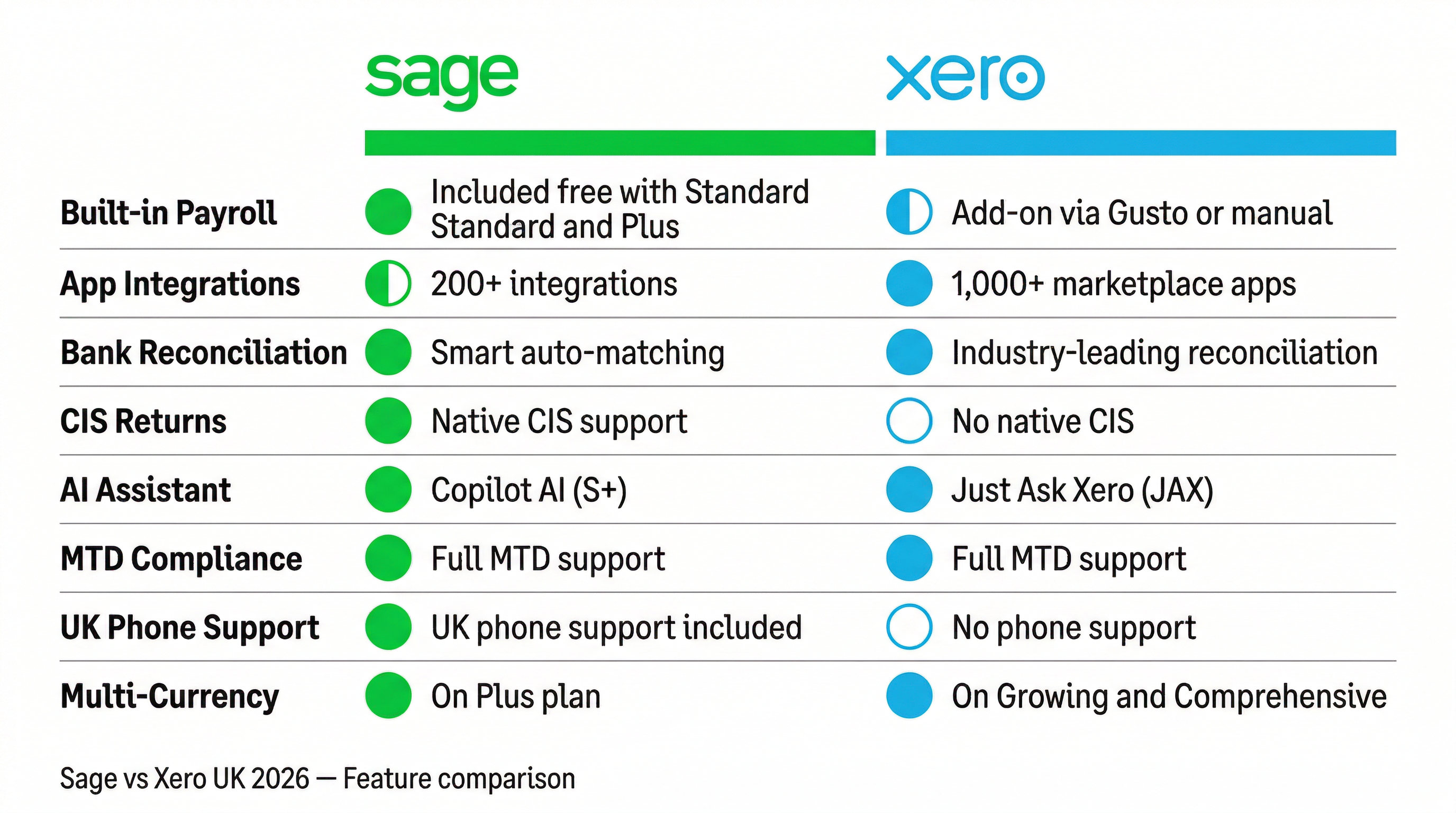
Sage's bundled payroll on the Standard plan makes it consistently cheaper than Xero for any UK business with employees. The saving grows with headcount. If you employ even one person, run the full payroll-inclusive numbers before deciding based on headline plan pricing alone.
Payroll: Feature Comparison
Price aside, how do the payroll products compare on capability? Sage has a 40-year heritage in UK payroll and it shows. Both platforms handle the core requirements — RTI filing with HMRC, payslip generation, statutory payments (SSP, SMP, SPP), and auto-enrolment pension contributions. But there are meaningful differences in depth and user experience.
| Payroll Feature | Sage Payroll | Xero Payroll |
|---|---|---|
| RTI submission to HMRC | Yes — direct, automated | Yes |
| P60, P45, P11D generation | Full suite included | P60 and P45 included; P11D basic |
| Auto-enrolment pension | NEST, NOW, People's, Smart — all major schemes | NEST and select providers |
| CIS payroll (subcontractors) | Fully integrated | Via third-party app |
| Director payroll | Yes, alternative NI calculation | Yes |
| Employee self-service portal | Yes — payslips, leave requests | Yes |
| Holiday and leave management | Basic (full in Sage HR) | Basic leave tracking |
| HMRC payment schedule | Automated reminders | Manual tracking |
Sage's payroll depth reflects its heritage. The P11D generation (for benefits in kind), the breadth of supported pension providers, and the native CIS payroll handling give it a meaningful edge for most UK employers. Xero's payroll is perfectly functional but feels like a newer, slightly thinner product by comparison.
Bank Reconciliation
This is one area where Xero has historically held an advantage, and that reputation is largely deserved — though Sage has closed the gap considerably with recent updates. Xero's bank reconciliation interface is widely considered the best in the SME market: clean, fast, and with matching suggestions that become impressively accurate over time as the algorithm learns your categorisation patterns.
Sage's bank reconciliation has improved substantially with the introduction of AI-powered matching and the Sage Copilot receipt categorisation feature. Connecting UK bank accounts (Barclays, Lloyds, NatWest, HSBC, Monzo, Starling, and others) works via Open Banking connections on both platforms. Both support automatic transaction feeds, though Sage's connections have been more reliable with some smaller UK banks historically.
For businesses with high transaction volumes — retail, hospitality, e-commerce — Xero's reconciliation interface is genuinely faster and more intuitive. For businesses with moderate transaction counts, the difference is marginal. Xero edges ahead here, but not by as much as it once did.
Invoicing
Both platforms offer professional invoicing with custom branding, automatic payment reminders, and direct payment links. Sage's invoicing includes a clean quote-to-invoice workflow and integrates tightly with its CRM-lite features (customer records, contact management). Xero's invoicing is similarly capable, with slightly more flexibility in invoice template customisation and a cleaner mobile experience.
One practical difference: Sage's invoice-to-cash tracking integrates more tightly with its bank feed, automatically matching payment receipts to outstanding invoices without user intervention. Xero does this too, but Sage's matching speed on the Standard plan has improved significantly. Neither platform has a clear winner here — both are strong.
VAT and Making Tax Digital
Both platforms are fully MTD for VAT compliant and have been since the programme launched. Both support direct HMRC submission, VAT return preparation, and the range of VAT schemes common in UK small business — standard, flat rate, cash accounting, and annual accounting. Sage has a slight edge in handling partial exemption scenarios and the Construction Industry Scheme (CIS) reverse charge VAT, which Xero handles less elegantly.
As MTD for Income Tax Self Assessment (ITSA) rolls out from April 2026, both platforms are developing compliant digital record-keeping tools for unincorporated businesses. Sage's MTD AI Agent — part of the Copilot suite — automates the quarterly submission process and flags potential issues before submission, a feature Xero does not yet match with equivalent agentic automation.
CIS (Construction Industry Scheme)
For UK businesses in construction — either as contractors, subcontractors, or those with subcontractors on their books — CIS handling is a genuine differentiator. Sage's native CIS support on the Standard plan covers: subcontractor verification with HMRC, automated CIS deduction calculation, CIS monthly returns, and CIS-adjusted payslips. It is fully integrated into both the payroll and accounting modules, with no third-party app required.
Xero handles CIS through integration with third-party apps such as Tradify or specialist CIS add-ons. While these integrations work, they add monthly cost, an extra layer of complexity, and a potential point of failure in your data flow. For any UK construction business — even a small sole-trader contractor — Sage's native CIS is a compelling reason to choose it over Xero.
AI Features: Sage Copilot vs Xero JAX
Both companies have invested heavily in AI during 2025–2026. Sage Copilot launched across all plans in 2024 and has expanded significantly. Xero's AI assistant, internally referred to as JAX (Xero AI Experience), has rolled out progressively across the product.
| AI Feature | Sage Copilot | Xero JAX |
|---|---|---|
| Receipt capture and categorisation | AI-powered, high accuracy | AI-powered via Hubdoc |
| Cash flow forecasting | Automated, scenario modelling | Short-term cash flow via Xero Analytics |
| MTD submission automation | MTD AI Agent (agentic) | MTD submissions — no agentic agent yet |
| Anomaly detection | Flags unusual transactions | Limited — in development |
| Natural language queries | Available on Copilot | JAX assistant — limited availability |
| Included with plan | Yes — all plans | Partial — varies by feature |
Sage Copilot is the more mature AI implementation as of 2026. The MTD AI Agent in particular — which proactively manages the compliance workflow rather than simply facilitating it — has no direct Xero equivalent. For AI enthusiasts or businesses where finance automation is a priority, Sage currently has the edge. Xero's AI roadmap is ambitious, but it is trailing Sage's implementation timeline in this area.
App Integrations and Ecosystem
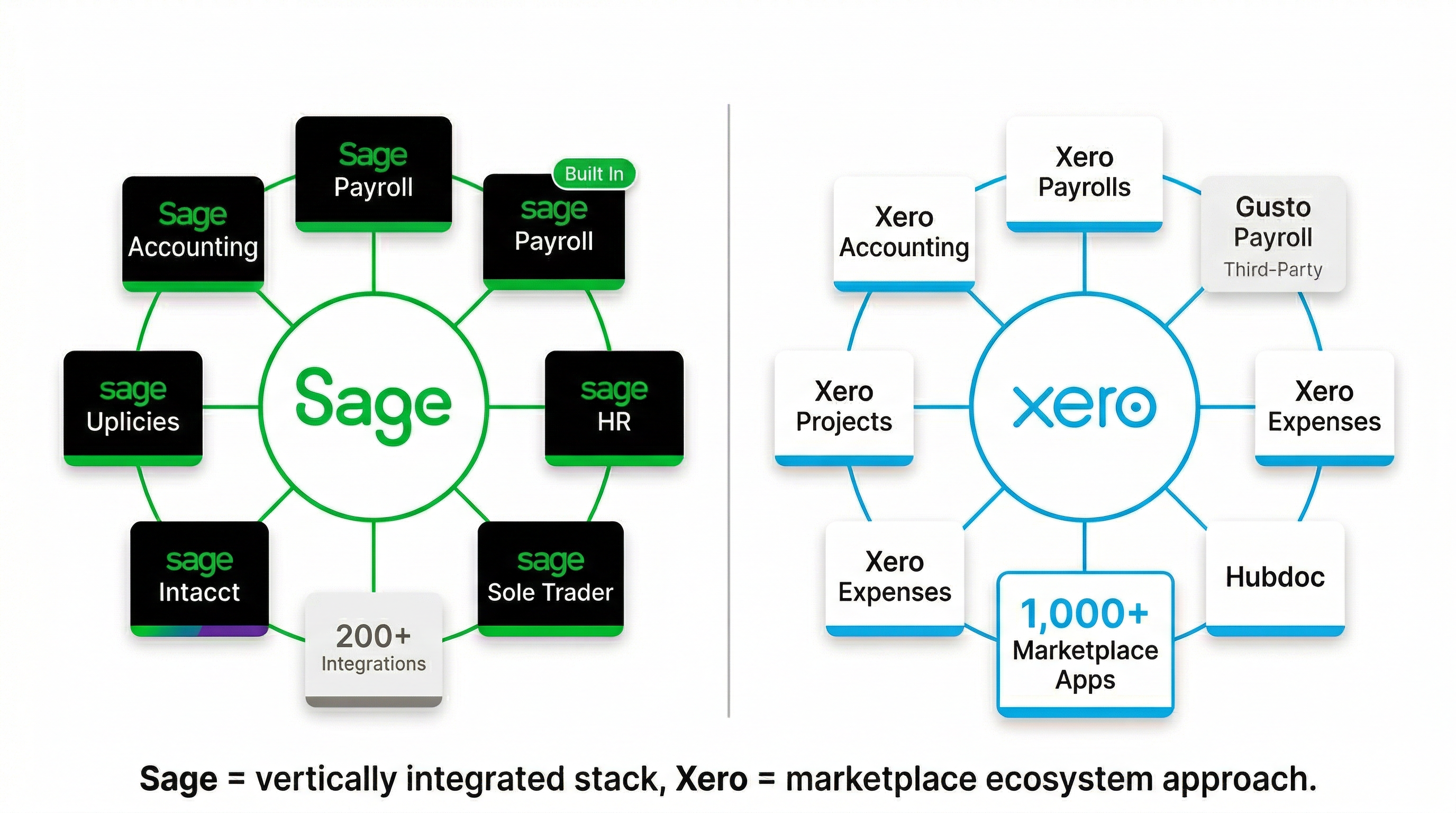
This is the area where Xero holds the clearest and most significant advantage. Xero's app marketplace contains over 1,000 third-party integrations — covering every imaginable business category from e-commerce (Shopify, WooCommerce, Amazon) to inventory (Unleashed, Cin7, Dear) to job management (Tradify, ServiceM8), payroll extensions, time tracking, and CRM platforms. The breadth and depth of the Xero ecosystem is genuinely impressive and represents a competitive moat that Sage has not yet fully closed.
Sage's app marketplace contains considerably fewer integrations — several hundred versus Xero's 1,000+. The core integrations that most businesses need (Stripe, GoCardless, Shopify, major CRM platforms) are available on both. Where Sage falls short is in the long tail of specialist integrations for niche industries or workflows. If your business relies on a specific third-party tool and it only integrates with Xero, that is a legitimate reason to choose Xero.
Xero's 1,000+ app marketplace is its strongest single competitive advantage over Sage. Before switching or choosing, check that every tool your business uses has a Sage integration. If your stack is Shopify + inventory management + CRM + time tracking, verify Sage compatibility for each. If one critical integration is Xero-only, that may settle the decision.
Reporting
Both platforms offer solid standard financial reporting. Profit and loss, balance sheet, cash flow statement, VAT return, and basic management reports are available on both. Sage's reporting has improved with custom report builder enhancements in 2025, allowing more flexible date ranges, department filtering, and custom column configurations.
Xero's reporting engine is generally considered more flexible and user-friendly, with cleaner presentation and easier-to-customise layouts. Xero Analytics Plus (available on Comprehensive and Ultimate plans) adds cash flow forecasting, business snapshot dashboards, and comparative period analysis that goes slightly beyond Sage's standard reporting. For businesses that live in their financial reports, Xero's reporting UX has the edge at equivalent plan levels.
Customer Support
This is a meaningful practical differentiator. Sage offers UK telephone support on all paid plans — you can call and speak to a person. For business owners who prefer talking through an issue rather than navigating a chat bot or submitting a support ticket, this matters.
Xero offers support primarily through email and in-app messaging, with no telephone support available. Response times are generally good and the quality of Xero's written support is high, but the absence of phone support is a consistent complaint from Xero customers who encounter urgent issues — a VAT return deadline approaching and a technical problem to resolve, for instance. For older business owners or those less comfortable with written support channels, Sage's phone option is a genuine practical advantage.
Mobile Apps
Both platforms have capable mobile apps for iOS and Android. Xero's mobile app is slightly more polished in terms of UX and consistently receives higher App Store and Google Play ratings. Sage's mobile app has improved significantly in recent updates and covers the key use cases — creating invoices, capturing receipts, checking cash position, and approving transactions. Neither app supports the full desktop feature set, which is normal and expected. Day-to-day on-the-go tasks work well on both.
Which UK Businesses Should Choose Sage?
- Any business with employees — the bundled payroll delivers immediate cost savings over Xero's per-employee model
- Construction businesses and contractors — native CIS handling without third-party apps
- Businesses that value phone support for urgent issues
- Businesses prioritising AI-powered automation, particularly for MTD compliance
- Those already in the Sage ecosystem (Sage 50, Sage HR) who benefit from native data flow
- Businesses that want bundled payroll, accounting, and VAT in one monthly fee without managing multiple software subscriptions
Which UK Businesses Should Choose Xero?
- Sole traders and freelancers with no employees, where the payroll cost advantage disappears
- Businesses relying on specialist third-party app integrations that are Xero-only
- E-commerce businesses with complex inventory management needs via Xero's partner ecosystem
- Businesses where the accountant or bookkeeper already uses Xero Practice Management and prefers a single platform
- Businesses where high transaction volume makes Xero's bank reconciliation UX a meaningful daily time saver
- Businesses on the Comprehensive plan (£50/month) with up to 10 employees — the all-in price is competitive at that specific tier
Our Verdict
Choose Sage If You Have Employees
The bundled payroll argument is compelling and consistent. At 5 employees, Sage Standard saves you £14.50/month versus Xero Grow with payroll. At 25 employees, that saving is £44.50/month — over £530 per year. Add native CIS for construction businesses and UK phone support, and Sage is the rational choice for the majority of UK small employers.
- Bundled payroll saves money from day one with any employees
- Native CIS handling is Sage-exclusive at this price point
- UK phone support for urgent issues
- Sage Copilot AI currently more mature than Xero JAX
Choose Xero for App Ecosystem and Bank Reconciliation
If your business depends on integrations with specialist tools, or if your accountant has built their practice around Xero, the ecosystem advantage is real. Xero's bank reconciliation UX remains the best in class for high-volume transaction matching, and the breadth of its 1,000+ app marketplace is genuinely unmatched in the SME accounting space.
- 1,000+ app integrations cover virtually every business need
- Best-in-class bank reconciliation interface
- Slightly better reporting UX on comparable plans
- Accountant adoption is high — many prefer working in Xero
Overall: Sage Wins for Most UK Small Businesses
Accounting for the full cost including payroll, support quality, CIS handling, and AI maturity, Sage edges ahead for the majority of UK small businesses with employees. The gap has narrowed considerably in recent years as Sage has modernised its platform. Xero remains the better choice for sole traders in app-heavy industries and for businesses whose accountants are embedded in the Xero ecosystem. This is a genuinely close competition — and for many businesses, either platform would serve well. The payroll bundling is the tipping point for most employers.