Sage Payroll UK 2026 — Is It the Best Value Payroll Software for Small Businesses?
A hands-on walkthrough of Sage Accounting's three UK plans — Start at £15/mo, Standard at £30/mo and Plus at £59/mo. We break down what each tier actually includes, from bank feeds and VAT returns on Start to CIS submissions and bundled payroll on Standard, all the way to unlimited users and multi-currency on Plus. Includes a look at Sage Copilot AI, MTD compliance, and who should pick which plan based on real business needs.
Ledger Businesses is reader-supported. When you buy through links on our site, we may earn an affiliate commission at no extra cost to you. Learn more.
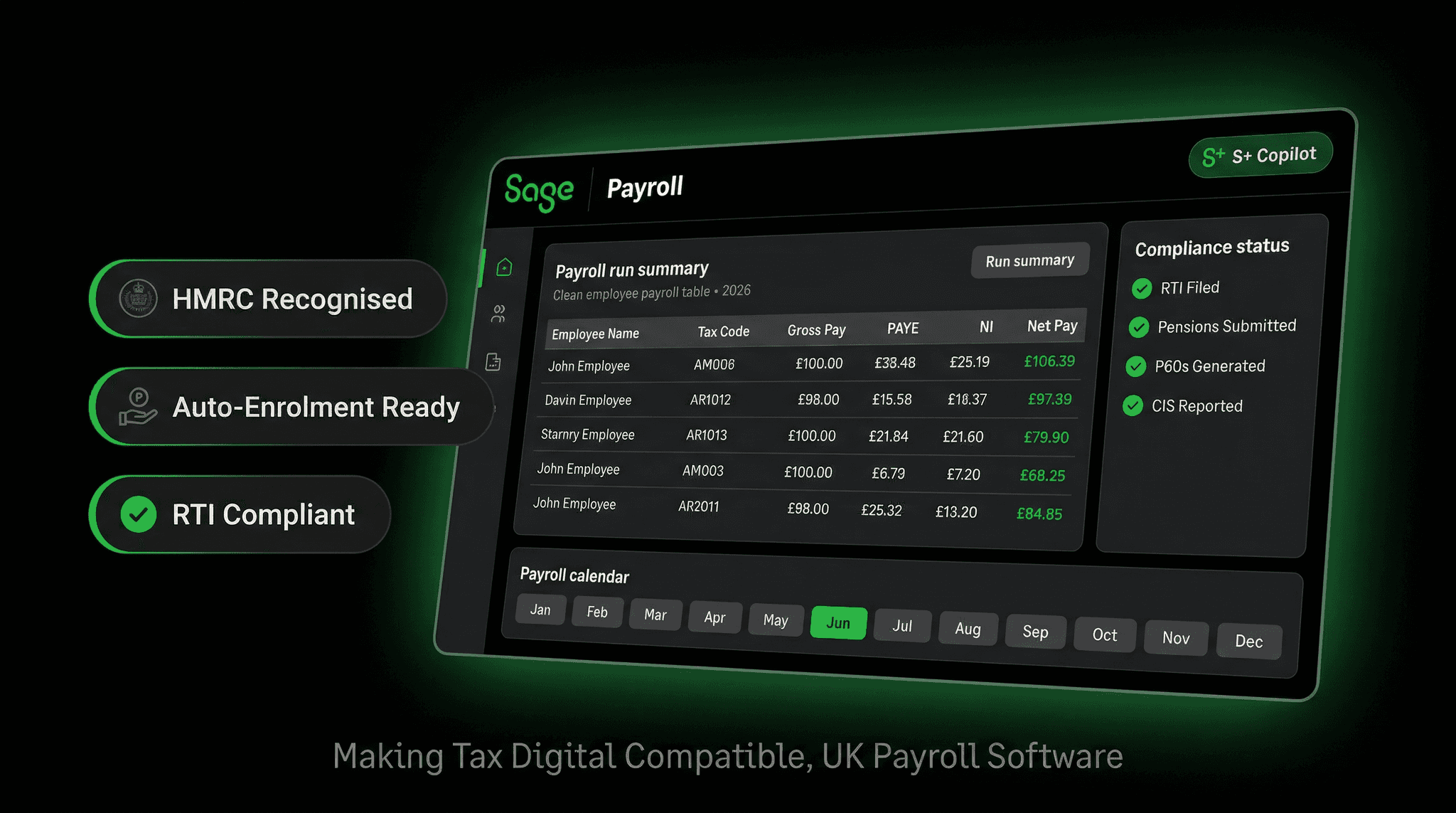
Running payroll in the UK involves navigating a tightly regulated framework of HMRC filings, statutory pay obligations, pension auto-enrolment duties and, for the construction sector, Construction Industry Scheme (CIS) requirements. The cost of getting it wrong — whether through an incorrect RTI submission, a missed P11D deadline or an auto-enrolment failure — can run to hundreds or thousands of pounds in HMRC penalties.
Sage Payroll has been a mainstay of UK payroll processing for decades. In 2026, it is available as a standalone subscription with three tiers — Essentials, Standard and Premium — and also bundled within Sage Accounting Standard and Plus plans for businesses with up to five employees. This review covers all three tiers in detail, including per-employee pricing, compliance features and how it compares to rival payroll platforms.
Sage Payroll plans (ex. VAT): Essentials £10/month (5 employees included, £2/extra), Standard £20/month (5 employees included, £4/extra), Premium £30/month (5 employees included, £6/extra). Payroll for up to 5 employees is bundled free within Sage Accounting Standard and Plus plans.
Sage Payroll — Overview and Market Position
Sage Payroll is a cloud-based payroll platform designed exclusively for UK businesses. Unlike some accounting software platforms that have bolted on payroll as an afterthought, Sage Payroll is a deep, purpose-built tool with comprehensive HMRC integration that covers every aspect of UK payroll processing from initial employee onboarding through to year-end submissions.
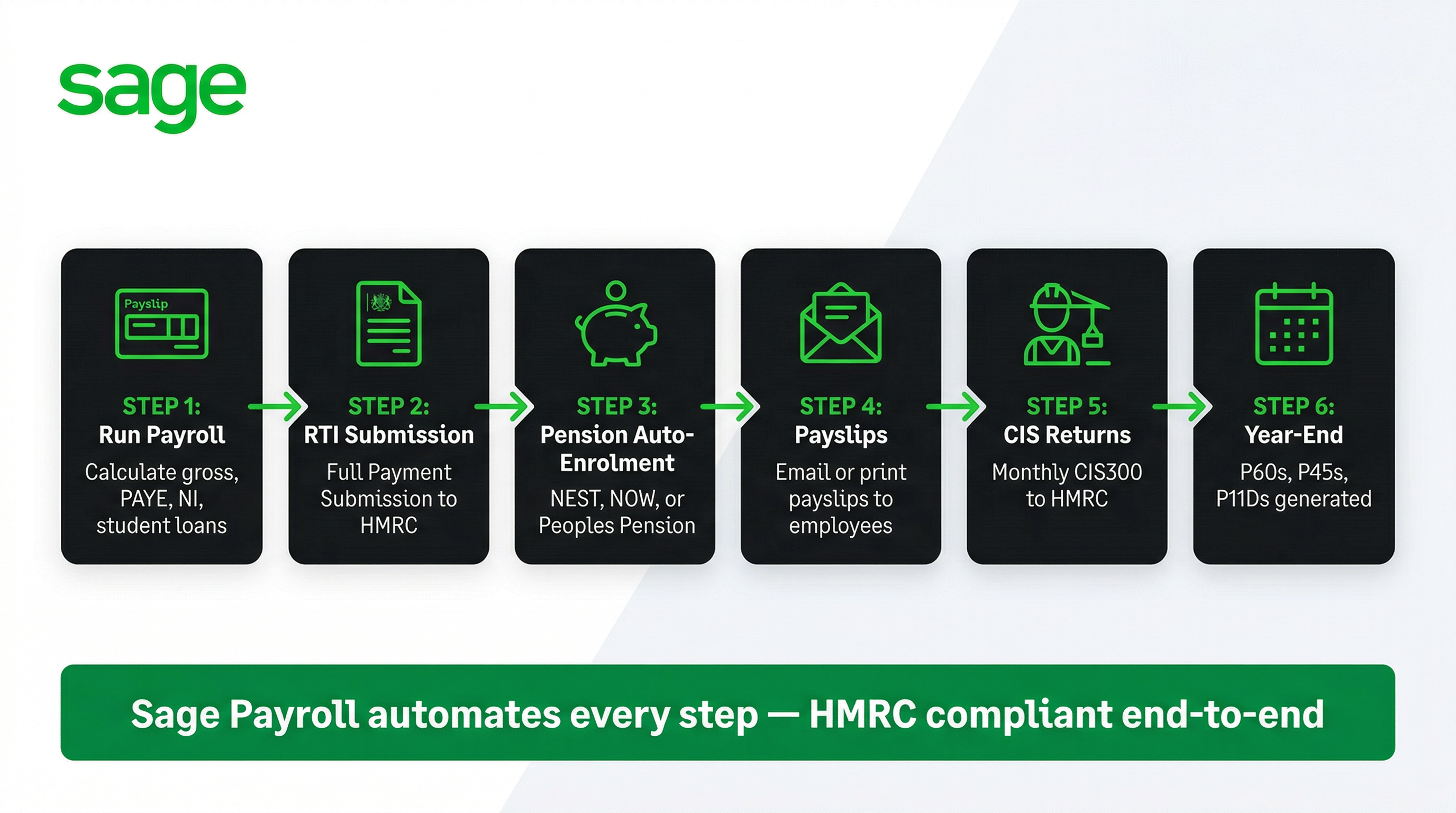
The platform handles Real Time Information (RTI) submissions directly to HMRC — a legal requirement for all UK employers since April 2013. It generates P60, P45 and P11D documents, calculates statutory payments (SSP, SMP, SPP, SAP), manages pension auto-enrolment through direct integration with approved pension providers, and for construction businesses, handles CIS deductions and contractor/subcontractor relationships.
Sage Payroll is also approved by HMRC as a recognised payroll software provider, a status that gives businesses confidence in its ongoing compliance with HMRC specification changes — including changes to tax codes, National Insurance thresholds, statutory pay rates and National Living Wage levels that occur each April.
Sage Payroll Plans and Pricing
Sage Payroll is structured across three tiers. All plans include a base allowance of five employees in the monthly subscription price. Additional employees above five are charged at a per-employee monthly rate that varies by tier.
| Plan | Monthly Price (ex. VAT) | Employees Included | Per Extra Employee | Best For |
|---|---|---|---|---|
| Essentials | £10/month | 5 | £2/employee/month | Small businesses, basic payroll needs |
| Standard | £20/month | 5 | £4/employee/month | Growing businesses, P11D, detailed reporting |
| Premium | £30/month | 5 | £6/employee/month | Larger businesses, advanced HR integration |
Understanding the Per-Employee Pricing Model
The per-employee pricing model means costs scale with your headcount. Here is how the monthly costs look for different employee counts across all three plans:
| Number of Employees | Essentials | Standard | Premium |
|---|---|---|---|
| 5 (included) | £10/month | £20/month | £30/month |
| 10 | £20/month | £40/month | £60/month |
| 15 | £30/month | £60/month | £90/month |
| 20 | £40/month | £80/month | £120/month |
| 25 | £50/month | £100/month | £150/month |
| 50 | £100/month | £200/month | £300/month |
The Essentials tier's low per-employee rate of £2 makes it extremely cost-effective for businesses with larger headcounts that only need basic payroll functionality. A 50-employee business on Essentials pays £100/month — significantly less than IRIS Payroll (from £850+/year for smaller configurations) and competitive with BrightPay (approximately £139+/year one-off licence but without cloud hosting or direct HMRC integration).
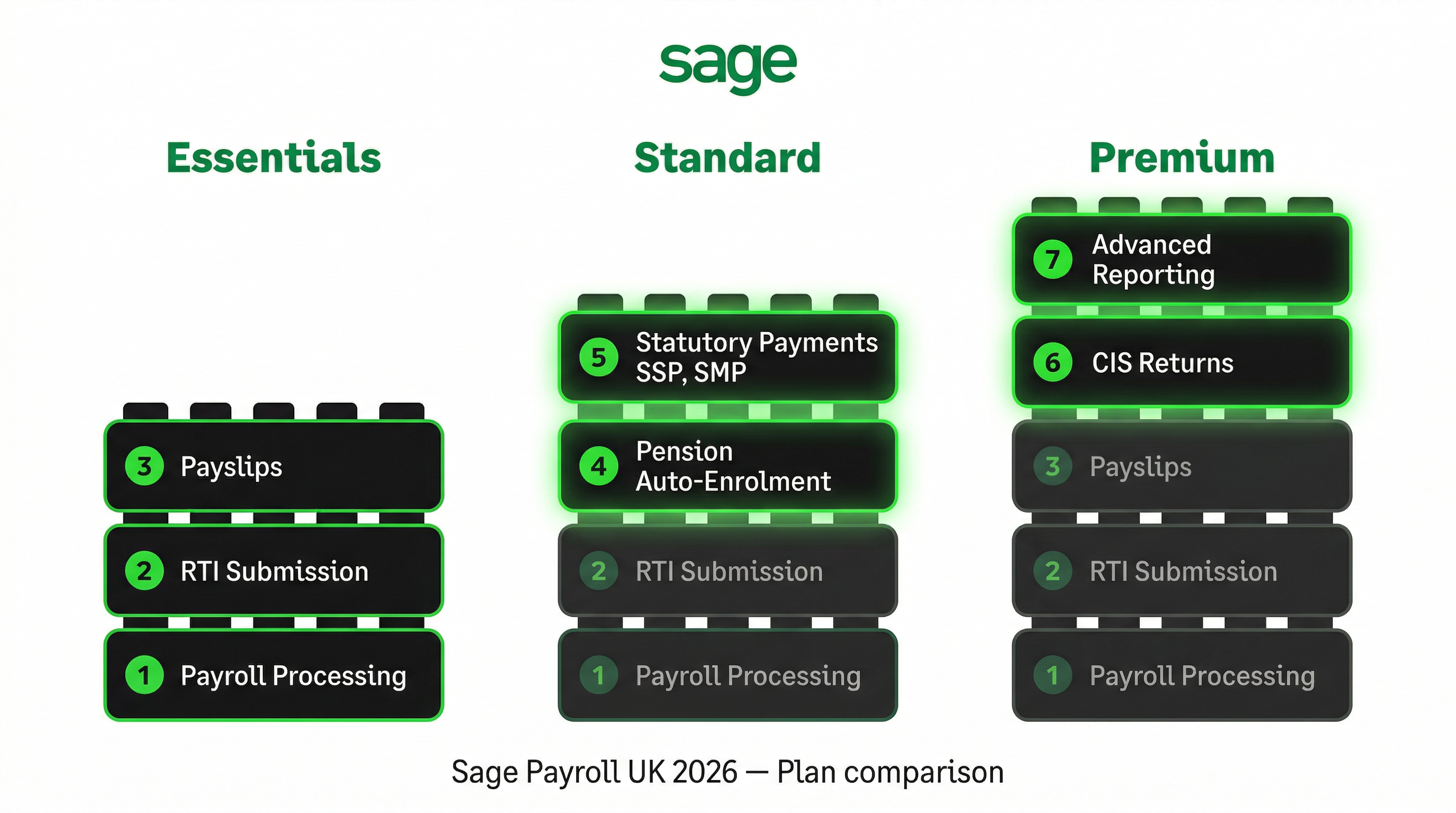
Sage Payroll Essentials — £10/Month
Essentials is the entry-level tier, designed for small businesses with straightforward payroll needs: regular monthly or weekly pay runs, standard PAYE calculations and basic year-end processing.
What Essentials Includes
- RTI (Real Time Information) filing — Full Employer Payment Summary (EPS) and Full Payment Submission (FPS) direct to HMRC every pay period
- PAYE calculations — Automatic income tax and National Insurance calculations using current HMRC tax codes and thresholds
- P60 generation — Year-end P60s for all employees in digital and printable format
- P45 generation — P45s for leavers, automatically notified to HMRC via RTI
- Statutory Sick Pay (SSP) — Automatic SSP calculations based on qualifying days and employee earnings
- Statutory Maternity Pay (SMP) — Calculation of SMP entitlement and duration
- Pension auto-enrolment — Automatic employee enrolment in a qualifying workplace pension scheme with contributions calculated per HMRC minimums
- Pension provider integration — Direct connectivity with NEST, NOW Pensions, People's Pension and Smart Pension
- Employee self-service portal — Employees can view payslips and P60s digitally without contacting the payroll administrator
- Multiple pay frequencies — Weekly, fortnightly, four-weekly and monthly pay runs
- National Living Wage compliance — Automatic alerts when an employee's pay rate falls below the current NLW for their age band
What Essentials Does Not Include
- P11D expenses and benefits reporting
- Advanced absence management and reporting
- CIS subcontractor payroll
- Detailed payroll analytics and reporting
- HR integration with Sage HR
Sage Payroll Standard — £20/Month
Standard builds on Essentials with the addition of P11D processing, more detailed payroll reporting, and expanded absence management. It is aimed at businesses that have moved beyond basic PAYE and need to handle employee expenses, benefits in kind, and more granular workforce data.
Everything in Essentials, Plus:
- P11D and P11D(b) filing — Report employee expenses and benefits in kind directly to HMRC. This is a legal requirement for any employee receiving taxable benefits (company cars, private medical, loans, etc.) and the ability to prepare and submit P11Ds within the payroll platform eliminates the need for a separate process or third-party tool
- Benefits in kind tracking — Record and calculate the cash equivalent value of benefits provided to employees throughout the tax year
- Advanced absence management — Track sick days, holidays, and other absence types with more detailed reporting; Bradford Factor calculations for managing frequent short-term absences
- Detailed payroll reports — Expanded suite of payroll analysis reports including pay type breakdowns, deduction summaries and employer cost reports
- Additional Statutory Payments — Statutory Paternity Pay (SPP), Shared Parental Pay (ShPP) and Statutory Adoption Pay (SAP) calculations alongside SSP and SMP
- Payroll journal export — Export payroll journals in formats compatible with Sage Accounting and other bookkeeping platforms for automatic posting to the general ledger
P11D returns must be filed with HMRC by 6 July each year for any employee receiving taxable benefits. The penalty for late or incorrect P11D filing is £300 per form plus £60 per day for continued failure. If your business provides any benefits in kind — including private medical insurance, company cars, or interest-free loans — you need a payroll plan that handles P11D. That means Standard or Premium, not Essentials.
Sage Payroll Premium — £30/Month
Premium is Sage Payroll's most comprehensive tier, designed for businesses with more complex payroll structures, larger workforces, or requirements for advanced HR data integration. It adds the most detailed reporting, the deepest Sage HR connectivity, and enhanced admin controls.
Everything in Standard, Plus:
- Advanced analytics and dashboards — Real-time payroll cost dashboards with headcount trends, employer cost breakdowns and pay type analysis
- Sage HR integration — Bi-directional data sync with Sage HR for seamless people data management — changes made in Sage HR (new starters, pay changes, leavers) automatically flow into Sage Payroll, eliminating duplicate data entry
- Custom payroll workflows — Create approval chains for pay changes and payroll sign-off before submission
- Enhanced employee portal — Extended self-service including the ability for employees to update personal details, bank account information and tax code queries directly in the portal
- Priority support — Elevated support access with faster response times during year-end and critical payroll periods
- Comprehensive audit trails — Full record of every change made to payroll data, by whom and when — important for financial governance and audit purposes
HMRC Compliance Features in Depth
Real Time Information (RTI) Filing
All three Sage Payroll tiers submit RTI data to HMRC automatically at each pay run. The Full Payment Submission (FPS) — which reports what you have paid employees and the tax and National Insurance deducted — must be submitted on or before the payment date. An Employer Payment Summary (EPS) is required when no employees are paid in a given month, or to claim statutory payment rebates from HMRC. Sage Payroll handles both automatically, including reminders when an EPS is due.
P60, P45 and Year-End Processing
P60s must be issued to all employees still employed on 5 April by 31 May each year. Sage Payroll generates P60s automatically at year-end in a format suitable for digital distribution through the employee portal. P45s for leavers are generated at the point of the employee's final pay run and the leaving notification is included in the next FPS submitted to HMRC.
Year-end in Sage Payroll involves running the year-end process (typically in late March or early April), confirming all employee data, submitting the final EPS for the year, and rolling the payroll into the new tax year with updated tax codes received from HMRC via P9 notifications. Sage Payroll handles all of these steps with guided prompts that walk the payroll administrator through the sequence.
Pension Auto-Enrolment
Auto-enrolment has been mandatory for all UK employers since 2018, but the administrative requirements remain ongoing: assessing employees each pay period, enrolling eligible workers, calculating and processing contributions, and communicating with the pension provider. Sage Payroll automates all of this.
Supported pension providers with direct integration include:
- NEST (National Employment Savings Trust) — the government-backed default provider
- NOW Pensions
- People's Pension
- Smart Pension
For businesses using other pension providers, Sage Payroll can export contribution data in formats compatible with most pension portals. The system automatically assesses each employee each pay period — distinguishing between eligible jobholders, entitled workers and non-eligible jobholders — and enr
Statutory Payments
All three Sage Payroll plans handle the full range of HMRC-mandated statutory payments:
- Statutory Sick Pay (SSP) — Calculated from the first qualifying day of absence after the waiting period, based on the employee's average weekly earnings
- Statutory Maternity Pay (SMP) — 90% of average weekly earnings for the first six weeks, followed by the statutory flat rate for up to 33 further weeks
- Statutory Paternity Pay (SPP) — Available on Standard and Premium; calculated at the statutory flat rate for one or two weeks
- Shared Parental Pay (ShPP) — Complex calculation of remaining SMP/SPP weeks shared between parents; Standard and Premium
- Statutory Adoption Pay (SAP) — Same structure as SMP, for adoption cases; Standard and Premium
HMRC updates statutory payment rates each April. Sage Payroll applies these updates automatically at the start of each new tax year, ensuring calculations are always current without manual intervention.
CIS Compliance in Sage Payroll
The Construction Industry Scheme (CIS) is a separate HMRC compliance framework that applies to contractors who pay subcontractors for construction work. CIS requires contractors to verify subcontractors with HMRC, apply the correct deduction rate (gross, standard 20%, or higher 30% for unregistered subcontractors), and submit a monthly CIS return to HMRC.
Sage Payroll, combined with Sage Accounting Standard or Plus (which includes native CIS support), provides a comprehensive CIS solution:
- Subcontractor verification — Verify subcontractor status directly with HMRC within the platform to determine the correct deduction rate
- Deduction calculation — Automatic application of gross, 20% or 30% rates based on verification status
- CIS payment and deduction statements — Generate statements for subcontractors showing gross payment, materials allowed and deduction made
- Monthly CIS return — Submit the monthly CIS return directly to HMRC from within Sage Accounting
- Reclaim tracking — Track CIS deductions suffered (if the business is also a subcontractor) for reclaim via the EPS
CIS return functionality sits within Sage Accounting (Standard or Plus), not within the standalone Sage Payroll product. For full CIS compliance — verification, deduction processing and monthly return — you need a Sage Accounting Standard or Plus subscription alongside Sage Payroll.
Integration with Sage Accounting
One of Sage Payroll's strongest practical advantages for businesses already using Sage Accounting is the native integration between the two products. When both platforms are connected:
- Each pay run automatically posts a payroll journal to Sage Accounting, recording gross pay, PAYE, NI, pension contributions and net pay to the correct nominal accounts
- Employer's National Insurance and pension contributions are automatically coded as employment costs
- No manual journal entry is required — eliminating a source of errors and saving the bookkeeper or accountant significant time each pay period
- Employee and employer details are shared between the systems, reducing duplicate data entry for new starters and changes
This integration is particularly valuable at year-end, when the combination of Sage Payroll's year-end reports and Sage Accounting's trial balance produces a comprehensive picture of employment costs with no reconciliation required between separate systems.
Sage Payroll vs Key Competitors
| Platform | Entry Price | Per Employee | RTI Filing | P11D | Auto-Enrolment | CIS |
|---|---|---|---|---|---|---|
| Sage Payroll Essentials | £10/mo | £2 (after 5) | ✓ | — (Standard+) | ✓ | Via Sage Acctg |
| QuickBooks Payroll | £8/mo | £2/employee | ✓ | — | ✓ | — |
| Xero Payroll | Add-on only | ~£5–£10/employee | ✓ | Limited | ✓ | — |
| BrightPay | ~£139+/year | Licence-based | ✓ | ✓ | ✓ | Limited |
| IRIS Payroll | £850+/year | Licence-based | ✓ | ✓ | ✓ | ✓ |
Against QuickBooks Payroll — its most direct cloud-based rival — Sage Payroll Essentials costs a little more at the base (£10 vs £8) but the per-employee rate is the same (£2). Sage's advantage lies in the depth of its P11D handling on Standard and Premium, the comprehensiveness of its pension auto-enrolment, and the native integration with Sage Accounting for payroll journal automation.
Against BrightPay, which remains popular among accountancy firms processing multiple client payrolls, Sage Payroll is more expensive for high employee counts but offers cloud hosting, automatic HMRC updates, and a self-service employee portal without the need for local software installation or manual software updates.
Strengths of Sage Payroll
- Complete RTI compliance — FPS and EPS submissions built into every pay run with no manual steps
- Comprehensive statutory payments — Full SSP, SMP, SPP, ShPP and SAP calculations on all tiers
- Pension auto-enrolment — Direct integration with four major UK pension providers; automatic assessment and enrolment each pay period
- P11D on Standard and Premium — One of the few mid-range payroll platforms to include P11D processing natively
- Native Sage Accounting integration — Automatic payroll journal posting eliminates manual bookkeeping
- HMRC-recognised software — HMRC recognition status means compliance with all current specifications and automatic updates for April tax year changes
- Employee self-service portal — Reduces payslip query volume significantly
- Scalable pricing — Per-employee pricing scales cleanly as headcount grows
Limitations of Sage Payroll
- P11D not on Essentials — Businesses with any benefits in kind must upgrade to Standard or Premium, at double or triple the base price
- Per-employee cost escalates on higher tiers — The £6/employee Premium rate becomes expensive at 20+ employees (£120/month for Premium vs £40 for Essentials)
- CIS requires Sage Accounting — CIS functionality sits in Sage Accounting, not in standalone Sage Payroll; businesses that use a different accounting platform cannot access Sage's CIS features without also subscribing to Sage Accounting
- HR integration only on Premium — The seamless Sage HR integration requires Premium; Essentials and Standard users must manage some data manually between systems
Sage Payroll Essentials — Best for Small Businesses
At £10/month with a £2 per-employee rate, Essentials delivers everything a small business needs for compliant payroll: RTI filing, P60/P45, SSP/SMP, pension auto-enrolment and a clean employee portal. Best for businesses with no taxable benefits in kind.
- Up to about 15 employees for cost-effective simple payroll
- No company cars, private medical or loans to employees
- Already using Sage Accounting Standard or Plus (payroll for 5 is bundled)
- Not in the construction industry (no standalone CIS need)
Sage Payroll Standard — Best for P11D and Growing Teams
Standard at £20/month adds P11D processing, more detailed reporting and the full range of statutory payment types. It is the right choice for any business that provides benefits in kind to employees or needs detailed payroll analytics.
- Any business providing company cars, private health or other taxable benefits
- Businesses needing SPP, ShPP or SAP alongside SSP and SMP
- Growing businesses that need proper payroll audit trails and reporting
- Those who export payroll journals to a separate accounting platform
Sage Payroll Premium — Best for Larger Businesses and HR Integration
Premium at £30/month is designed for businesses with 20+ employees, complex approval workflows, or a Sage HR subscription that needs seamless bi-directional data sync with payroll.
- Businesses using Sage HR that want automated data sync
- Businesses needing approval workflows for payroll sign-off
- HR and finance teams that need detailed dashboards and headcount analytics
- Organisations with strong governance requirements requiring full audit trails