Sage Intacct UK Review 2026: Is It Worth £20,000+ a Year for Growing Businesses?
In-depth Sage Intacct UK review for 2026. Pricing from £6,500/year, features, implementation timeline, and who should upgrade from Sage Accounting.
Ledger Businesses is reader-supported. When you buy through links on our site, we may earn an affiliate commission at no extra cost to you. Learn more.
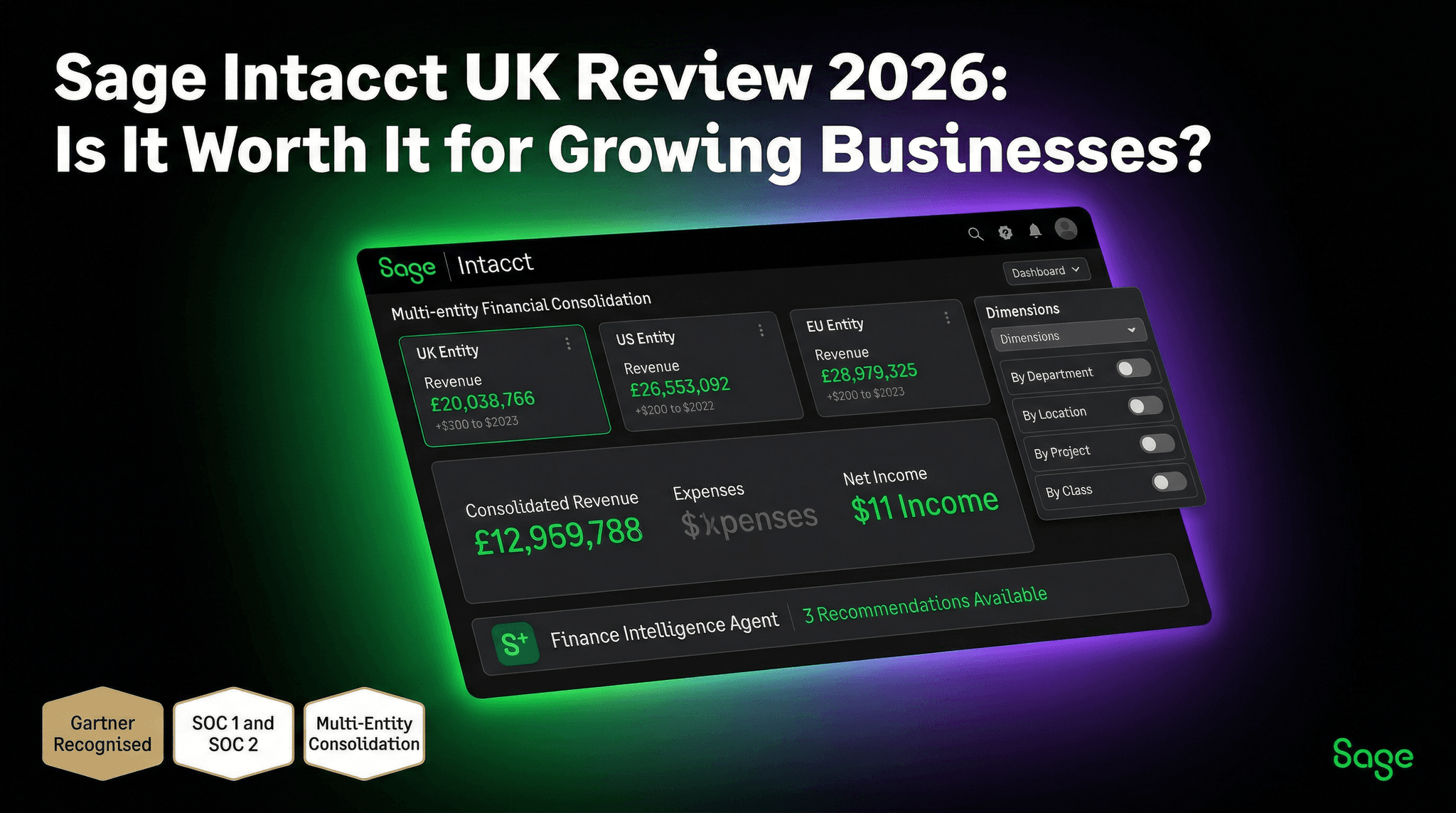
Sage Intacct occupies a very specific position in the UK accounting software market: it is emphatically not for everyone, and it is not designed to be. At a starting price of £6,500 per year — rising to £12,000 and beyond for more capable tiers — this is cloud ERP territory, aimed squarely at mid-market businesses that have grown beyond what Sage Accounting, Xero, or QuickBooks can handle. For the right organisation, it is transformative. For the wrong one, it is an expensive distraction.
This review covers every aspect of Sage Intacct's UK offering as of 2026: pricing and plan structure, the core financial management capabilities that distinguish it from SME software, the Sage Copilot AI features now embedded in the platform, implementation realities, and the honest answer to when you should — and should not — consider it.
Sage Intacct is best suited to UK businesses with £5M+ turnover, multiple entities, complex project accounting needs, or board-level reporting demands that spreadsheets and SME software can no longer satisfy. Below that threshold, Sage Accounting Plus at £59/month delivers strong value without the complexity or cost.
What Is Sage Intacct?
Sage Intacct is a cloud-based financial management platform, originally founded in the United States in 1999 and acquired by Sage Group in 2017. Since the acquisition, Sage has invested heavily in localising Intacct for the UK market, building in HMRC-compliant VAT handling, Making Tax Digital (MTD) readiness, and integration with UK banking infrastructure. It holds the AICPA's preferred financial management solution designation — a hallmark of its standing in the accounting profession.
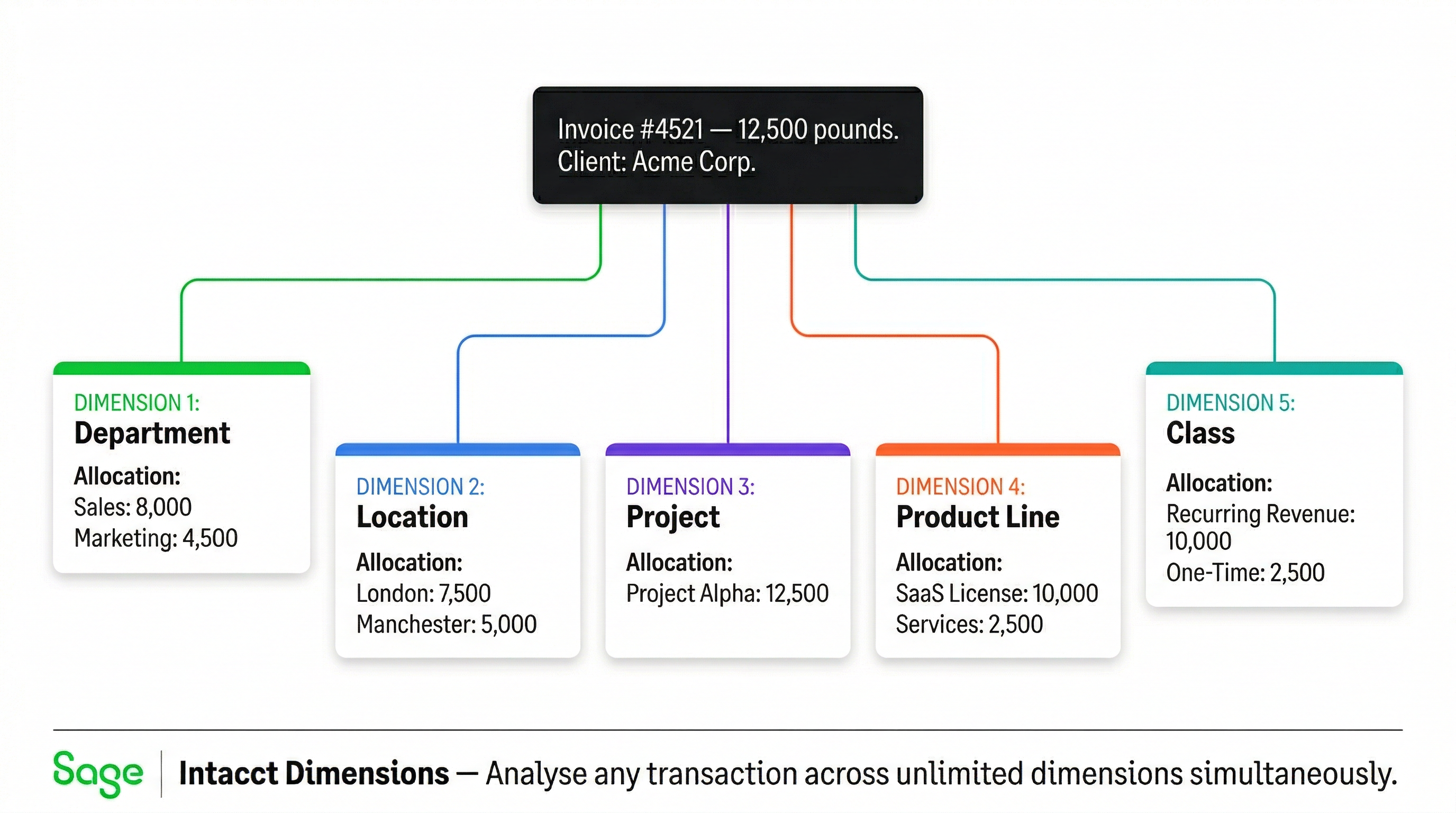
Unlike Sage Accounting (previously Sage Business Cloud Accounting), which is designed for sole traders to small businesses, Intacct is built on a fundamentally different architectural philosophy. At its core is a multi-dimensional chart of accounts that lets finance teams slice and analyse data across unlimited dimensions — department, location, project, fund, class, or any custom dimension you define. This approach renders traditional account code proliferation obsolete and enables genuinely sophisticated reporting without manual consolidation work.
In the UK, Sage Intacct is sold and implemented through a network of accredited partners rather than direct self-service signup. This partner-led model reflects the platform's complexity and the need for proper configuration to match your business structure.
Sage Intacct UK Pricing (2026)
Sage Intacct pricing in the UK is subscription-based, billed annually, and structured across three tiers. Unlike SME software that publishes a fixed monthly price, Intacct pricing varies based on modules, number of users, transaction volumes, and implementation scope. The figures below represent published starting points — your actual quote will depend on your requirements.
| Plan | Starting Price | Billing | Best For |
|---|---|---|---|
| Intacct Essentials | From £6,500/year | Annual subscription | Single-entity businesses moving from SME software; basic multi-dimensional reporting |
| Intacct Pro | From £12,000/year | Annual subscription | Multi-entity groups; advanced consolidation; project accounting; grant management |
| Intacct Bespoke | Custom pricing | Annual subscription | Large enterprises; complex multi-entity structures; custom integrations; global operations |
On top of the core platform fee, most implementations involve additional costs for specific modules. The general ledger, accounts payable, accounts receivable, and cash management modules form the base. Advanced modules — such as project accounting, contract revenue management, multi-entity consolidation, and fixed assets — are priced separately and can add several thousand pounds annually. Implementation fees charged by partners typically range from £5,000 to £30,000+ depending on complexity, with ongoing support retainers common for larger deployments.
When factoring in platform licence, modules, implementation, and ongoing partner support, a typical UK mid-market Sage Intacct deployment runs £15,000–£40,000 in the first year. Year two onwards reduces significantly as implementation costs fall away, but organisations should budget at least £10,000–£20,000 per year for the platform alone.
Core Financial Management Features
Multi-Dimensional Chart of Accounts
This is the architectural foundation that separates Intacct from everything below it. In traditional accounting software, if you want to track revenue by region, department, and product line simultaneously, you end up creating dozens or hundreds of account codes — a maintenance nightmare that makes year-end consolidation painfully slow. Intacct's dimensional approach lets you define those attributes as dimensions, tagging every transaction across multiple dimensions at the point of entry.
The result is a reporting engine of genuine power. A finance director can pull a P&L by London office, for the consulting department, across the last two quarters, without a single spreadsheet pivot table. The data is live, always reconciled, and accessible to any authorised user on any device. For UK businesses operating across multiple sites, cost centres, or service lines, this capability alone can justify the platform.
Multi-Entity Consolidation
For businesses operating multiple legal entities — subsidiaries, holding companies, joint ventures, or international branches — Intacct's consolidation module is genuinely impressive. Intercompany eliminations happen automatically. Currency translation for entities operating in different currencies is handled in real time. Consolidated IFRS or UK GAAP-compliant financial statements can be produced at the click of a button, rather than through a laborious month-end consolidation process.
UK holding companies with subsidiaries in Europe or further afield will find this particularly valuable. The platform supports over 160 currencies, and exchange rate tables update automatically. For groups that currently consolidate in spreadsheets — spending days each month reconciling intercompany balances — this is a significant operational step forward.
Project Accounting
Sage Intacct's project accounting module is purpose-built for professional services firms, consultancies, construction companies, and any business where revenue is tied to specific projects or contracts. It handles the full project lifecycle: budgeting, resource allocation, time and expense capture, billing milestones, revenue recognition, and project profitability reporting.
For UK professional services firms navigating IFRS 15 revenue recognition requirements, the contract revenue management module provides compliance-ready tools that would otherwise require expensive custom development or bolt-on software. Firms billing on time-and-materials, fixed-fee, or milestone basis can all be accommodated within the same platform.
Multi-Currency and Global Capabilities
Multi-currency in Intacct goes well beyond what Sage Accounting Plus offers. Every transaction can be denominated in any currency, with triangulation through a base currency and reporting in any combination. Realised and unrealised foreign exchange gains and losses are calculated and posted automatically. Bank accounts in multiple currencies are reconciled without manual conversion. For UK businesses with significant international trade or overseas entities, this is a material capability difference.
Advanced Accounts Payable and Receivable
Intacct's AP and AR modules go considerably deeper than SME software equivalents. On the AP side: three-way purchase order matching, dynamic discounting, multi-level approval workflows, and vendor payment runs with bank file generation in standard UK formats (BACS, Faster Payments). On the AR side: automated dunning sequences, customer credit limit management, complex billing schedules, and direct integration with collections management workflows.
Sage Copilot: The Finance Intelligence Agent in Intacct
Sage's AI strategy has evolved rapidly since the initial launch of Sage Copilot across its SME products. In Intacct, the AI capabilities are branded as the Finance Intelligence Agent — a more powerful implementation of the underlying Copilot technology, tailored to the data richness and complexity of mid-market finance operations.
What the Finance Intelligence Agent Does
At its core, the Finance Intelligence Agent analyses patterns across your Intacct data to surface anomalies, predict outcomes, and automate routine judgements. Practically, this means:
- Anomaly detection — the AI flags transactions that deviate from established patterns, such as duplicate invoices, unusual vendor payment amounts, or expenses coded to the wrong dimension. This reduces audit risk and catches errors before they compound.
- Cash flow intelligence — drawing on historical payment patterns, open AR aging, and upcoming AP obligations, the agent produces rolling cash flow forecasts that update automatically as new data arrives. Finance teams can model scenarios (what if this large debtor pays 30 days late?) without manual spreadsheet work.
- Automated period close assistance — the agent identifies open items, unreconciled accounts, and missing accruals as you approach month end, presenting them as a prioritised checklist rather than leaving your team to hunt through the ledger manually.
- Natural language queries — users can ask questions in plain English ("What was our gross margin in the North West region last quarter?") and receive instant answers drawn from live data, without needing to build a report from scratch.
These are not superficial features layered on top of existing functionality. Because Intacct's data architecture is cleaner and more structured than SME platforms, the AI has richer material to work with, producing more reliable outputs. The anomaly detection in particular becomes more valuable over time as the model learns your business's normal patterns.
Sage's Finance Intelligence Agent in Intacct represents a meaningful step beyond the Copilot features in Sage Accounting. The richer data structure of Intacct — multi-dimensional, multi-entity, with deep transaction history — gives the AI substantially more to work with, resulting in more accurate anomaly detection and more reliable forecasting outputs.
Reporting and Business Intelligence
Reporting is one of Intacct's most significant competitive advantages over SME alternatives. The built-in report writer allows finance teams to construct virtually any report without writing code or exporting to Excel. Standard reports cover the full range of financial statements — P&L by dimension, balance sheet, cash flow statement, trial balance, AR aging, AP aging, and more — but the real power is in custom report creation.
The Sage Intacct Interactive Visual Explorer provides dashboard-style data visualisation with drill-through capability. A CFO can look at a consolidated P&L for the group, click on a specific expense line, and drill through to the underlying transactions across all entities in seconds. This level of transparency and speed is simply not achievable in software designed for single-entity SMEs.
For listed companies or those preparing for investment, the ability to produce board-ready financial packs directly from the accounting system — rather than reconstructing them in PowerPoint each month — represents a genuine time saving. Finance teams at Intacct clients frequently report reducing their monthly close cycle by 30–50% after implementation.
Integration Ecosystem
Sage Intacct integrates with a substantial range of enterprise and mid-market applications through its open API and a growing marketplace of pre-built connectors. Key UK-relevant integrations include:
- Salesforce CRM — bidirectional sync of customer, opportunity, and invoice data, enabling accurate revenue forecasting and eliminating duplicate data entry between sales and finance
- Sage HR and Sage People — payroll and HR data flows directly into Intacct for labour cost allocation by project, department, or dimension
- Expensify, Concur, and Payhawk — expense management platforms sync approved expenses directly into Intacct AP with full dimension tagging
- Stripe, GoCardless, and major UK payment processors — payment data reconciles automatically against AR invoices
- Procurement and inventory systems — including NetSuite WMS, Unleashed, and several warehouse management platforms via API
The API-first architecture means that bespoke integrations with proprietary systems — ERP, CRM, or industry-specific platforms — are achievable, though they require development resource either in-house or through a Sage partner.
MTD and UK Compliance
Sage Intacct is fully compliant with the current UK MTD for VAT requirements, with direct HMRC submission built into the platform. As MTD for Income Tax Self Assessment (ITSA) rolls out across unincorporated businesses in 2026–2027, and as HMRC extends MTD requirements progressively, Intacct's compliance architecture means updates are pushed automatically rather than requiring manual software upgrades.
For larger businesses navigating UK-specific tax complexities — partial exemption VAT, Construction Industry Scheme (CIS) for those operating in or adjacent to construction, or complex transfer pricing across entities — Intacct provides the structural foundation to handle these correctly, supplemented by your accountant or tax adviser for the technical judgements.
Implementation: What to Expect
Sage Intacct implementations in the UK are conducted by authorised Sage partners — typically accounting technology consultancies or specialist finance system implementers. The timeline and complexity depend heavily on how many modules you need, how many entities you're consolidating, and the quality of your existing financial data. Realistic expectations:
| Scenario | Typical Timeline | Key Risks |
|---|---|---|
| Single entity, straightforward migration from Sage Accounting | 6–8 weeks | Data migration quality; chart of accounts redesign |
| Multi-entity (2–5 entities) with consolidation | 10–14 weeks | Intercompany elimination configuration; dimension design |
| Project accounting with CRM integration | 12–18 weeks | Integration testing; revenue recognition configuration |
| Full enterprise deployment, multiple modules | 16–26 weeks | Change management; parallel running; user adoption |
The most common implementation failure is underestimating data migration complexity. Businesses migrating from spreadsheets or poorly structured legacy systems frequently discover that their historical data requires significant cleansing before it can be imported into Intacct. Allocating proper time and resource to the data preparation phase is the single most important factor in a successful go-live.
Training is another area where organisations should not cut corners. Intacct's power comes with complexity, and finance teams unfamiliar with dimensional accounting concepts will need structured onboarding. Most partners include a training programme in their implementation package; ensure this is adequate before signing the contract.
Sage Intacct vs Sage Accounting: When to Upgrade
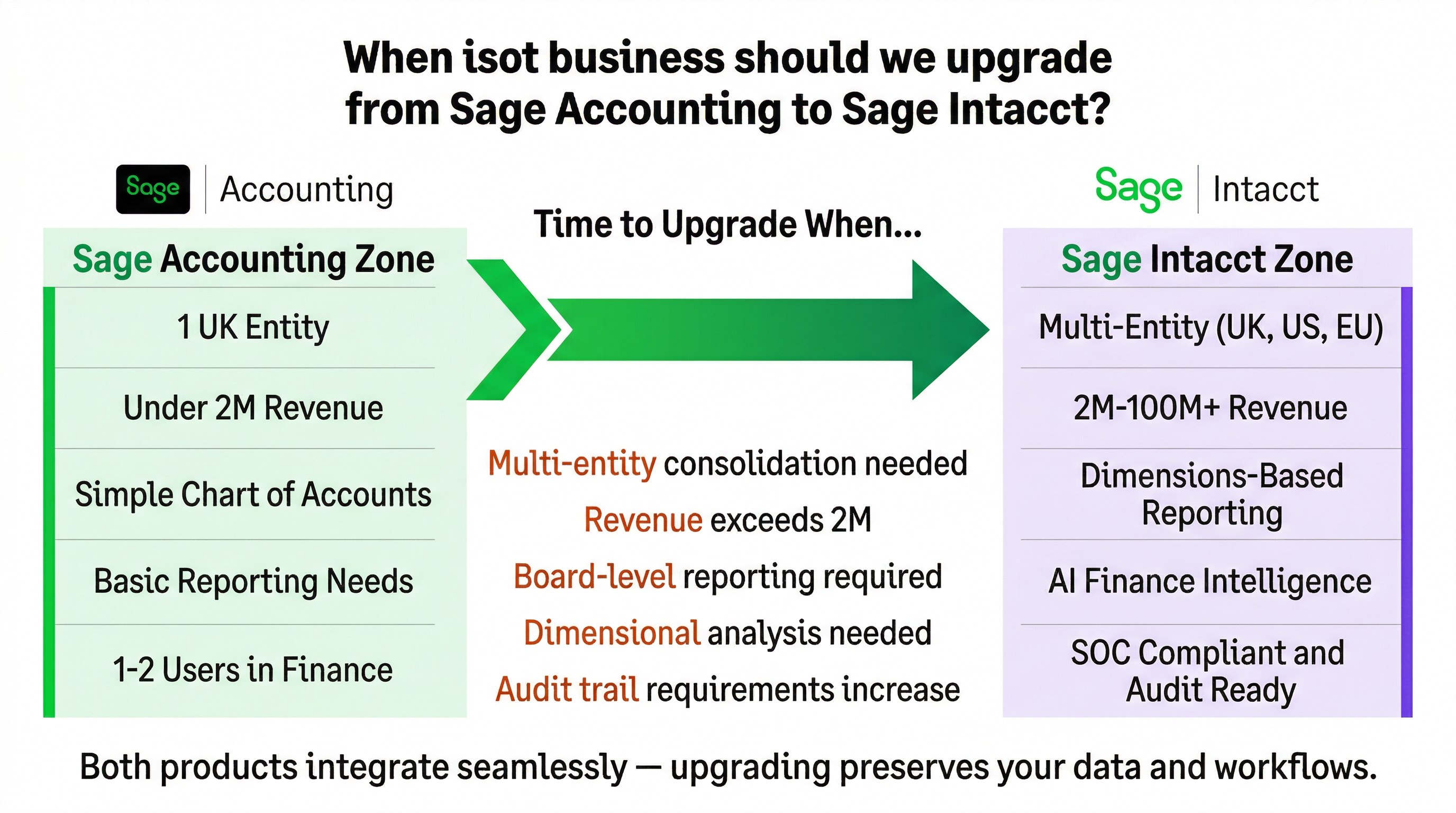
This is the question most growing UK businesses actually need answering. Sage Accounting Plus at £59/month is a genuinely capable platform. So at what point does the jump to Intacct at £6,500/year make sense?
| Capability | Sage Accounting Plus | Sage Intacct Essentials |
|---|---|---|
| Number of legal entities | 1 | Unlimited |
| Dimensions / cost centres | Basic (departments) | Unlimited custom dimensions |
| Automated consolidation | Manual / external | Built-in, with FX translation |
| Project accounting | Limited | Full lifecycle management |
| Revenue recognition (IFRS 15) | Not supported | Configurable recognition schedules |
| Custom financial reporting | Standard reports | Full report writer + visual explorer |
| Approval workflows | Basic | Multi-level, configurable |
| Audit trail | Standard | Comprehensive, immutable |
| Annual cost | £708 | From £6,500 |
The gap between these two products is not incremental — it is architectural. Intacct is a fundamentally different class of software. The question is not "which has more features" but "does our business complexity justify the investment?"
Signs You Are Ready for Intacct
- You operate two or more legal entities and consolidate manually in spreadsheets each month
- Your finance team spends more than two days on month-end close
- Your chart of accounts has grown unwieldy with hundreds of account codes attempting to replicate dimensional reporting
- You have external investors or a board requiring sophisticated financial reporting on short turnaround
- Your revenue recognition is complex — milestone billing, percentage completion, or subscription deferred revenue
- You are preparing for an audit, IPO, or sale process and need institutional-grade financial records
- Your turnover exceeds £5M and you are managing significant project-based revenue
Signs You Should Stay on Sage Accounting
- You operate as a single entity with straightforward revenue streams
- Your turnover is below £5M with no near-term multi-entity plans
- Your month-end close is manageable and your reporting needs are met by standard P&L and balance sheet
- You have fewer than 15 staff and no dedicated finance function beyond a part-time bookkeeper and external accountant
- Budget constraints make a £6,500+ annual platform fee genuinely prohibitive
Sage Intacct vs NetSuite: The Other Mid-Market Option
NetSuite is the other ERP platform commonly considered alongside Intacct by UK mid-market businesses. At £40,000–£100,000 per year for a typical UK deployment, NetSuite is significantly more expensive and broader in scope — it includes CRM, e-commerce, and supply chain management in addition to core financials. For businesses that need a single platform spanning operations beyond finance, NetSuite can be appropriate. For those whose primary requirement is best-in-class financial management, Intacct typically delivers more financial sophistication at considerably lower cost.
The other important difference is the Sage ecosystem. Businesses already on Sage Accounting or Sage 50 can migrate to Intacct with familiar data structures and the same Sage partner network. Chart of accounts, supplier records, and customer data migrate more cleanly than moving to an entirely different vendor's platform.
Support and Service
Sage Intacct customers receive support through their implementation partner as the first line of contact, supplemented by Sage's enterprise support team for platform-level issues. Unlike Sage's SME products where support is handled directly by Sage, the partner model means your day-to-day relationship is with your implementation consultancy. The quality of this relationship — and choosing the right partner initially — is therefore critical.
Sage maintains a dedicated Intacct community portal with extensive documentation, user guides, and a peer community of finance professionals sharing configurations and best practices. For self-sufficient finance teams, the documentation quality is high. For businesses without an in-house finance systems expert, maintaining a partner retainer post-implementation is advisable.
Our Verdict
Sage Intacct is Worth the Investment If...
Your business has grown to the point where manual consolidation, spreadsheet-based reporting, and single-entity accounting software are genuinely constraining your finance function. The ROI from accelerated close cycles, eliminated manual consolidation work, and better decision-making from real-time dimensional reporting is real and measurable.
- Multi-entity businesses consolidating across 2+ legal entities
- Professional services firms managing project profitability at scale
- Businesses preparing for investment, audit, or sale
- Organisations needing IFRS 15-compliant revenue recognition
- Finance teams spending 3+ days on monthly close
Stick With Sage Accounting Plus If...
You operate as a single legal entity with straightforward financials and your current close cycle is manageable. Sage Accounting Plus at £59/month delivers excellent value for growing SMEs, and the jump to Intacct represents a major step in cost, complexity, and implementation burden. There is no shame in staying at the right level for your current needs.
- Turnover below £5M with one legal entity
- Standard invoicing, expenses, and bank reconciliation requirements
- No external investor reporting demands
- Lean finance team without a dedicated systems administrator
Overall Assessment
Sage Intacct earns its position as one of the leading mid-market financial management platforms available in the UK. Its dimensional reporting, automated consolidation, and project accounting capabilities are genuinely best-in-class for businesses that have outgrown SME tools. The Finance Intelligence Agent represents a meaningful AI capability that will compound in value as the platform accumulates more of your financial history. The investment is substantial, but for the right business, the return on that investment — in finance team efficiency, reporting quality, and reduced close cycles — typically justifies the cost within 12–18 months. At £6,500/year entry level, Intacct is not as far out of reach as many assume, provided your business complexity warrants it.